Policies & Guidelines
The Journal of Animal Ecology and Environmental Sustainability (AEES) is committed to upholding the highest standards of scholarly publishing, transparency, and research integrity. AEES adheres to the ethical and publication guidelines recommended by Committee of Publication Ethics (COPE), Directory of Open Access Journals (DOAJ), and Higher Education Commission (HEC). These policies apply to all authors, editors, reviewers, and participants in the publication process.
Aim and Scope
AEES publishes original research articles, reviews, short communications, and methodological studies in the fields of animal ecology, biodiversity conservation, ecosystem management, climate change impacts, and environmental sustainability. The journal aims to provide a multidisciplinary platform for researchers, scholars, and practitioners to share innovative findings, promote collaboration, and address global ecological and sustainability challenges. Our goal is to foster scientific knowledge that contributes to the understanding and management of ecological systems and sustainable environmental practices.
Editorial Governance and Independence
The journal’s editorial team, led by the Editor-in-Chief, is responsible for all editorial decisions. AEES ensures that all decisions are based solely on scientific quality, originality, and relevance. The editorial process operates independently of the publisher, sponsors, or external pressures. The editorial policies are transparent and regularly reviewed to maintain accountability and uphold international standards in scholarly publishing.
Research and Publication Ethics
Editors and Referees
Editors and referees of the Journal of Animal Ecology and Environmental Sustainability (AEES) are required to declare any conflicts of interest related to the manuscript they are asked to evaluate. To ensure a transparent double-blind peer-review process, the identities of the authors are not disclosed to the referees, and vice versa. As per the journal’s policy and HEC guidelines for research journals, manuscript submissions by editors, associate editors, or any member of the editorial board are not permitted.
Authors
Authors are expected to adhere to ethical standards in both their research and writing, ensuring the following:
§ The submitted manuscript or any essential content has not been published previously in a peer-reviewed journal and is not being considered for publication elsewhere. To verify this, the editors utilize anti-plagiarism software such as Turnitin.com.
§ All relevant published material and sources referenced in the manuscript must be properly cited following the AMA Manual of Style.
§ Authors must acknowledge funding sources and any significant assistance received in the research, clearly stating these under the section “Compliance with Ethical Standards” at the end of the manuscript.
It is the responsibility of the authors to obtain consent from parties with vested interests. If any part of the manuscript is found to have been previously published or if unethical conduct is discovered, AEES may take the following actions:
§ Issue a public notice
§ Retract the paper
§ Prevent the corresponding author from submitting future work to AEES
§ Report the issue to the corresponding author, co-authors, employer, department head, funding body, and relevant authorities, including HEC.
Experimental Ethics
For studies involving human or animal subjects, authors must submit biosafety and bioethical approval from the relevant statutory bodies. Authors must comply with internationally recognized reporting guidelines:
§ CONSORT for clinical trials
§ PRISMA for systematic reviews
§ STROBE for observational studies
§ ARRIVE for animal research
§ CARE for case reports
Trial Registration
Clinical trials must be registered in a recognized public registry such as ICTRP or clinicaltrials.gov before recruiting participants. Registration information, including study protocols and primary outcomes, must be included in the manuscript. Trials conducted in Pakistan must adhere to DRAP and other relevant regulations.
Non-compliance may result in requests for revision or rejection.
Complaints
AEES will publish corrections for significant errors caused by author mistakes (Corrigenda) or editorial errors (Errata). In case of serious complaints regarding the journal’s procedures, the Editor-in-Chief will discuss the issue with the corresponding author and relevant members of the editorial board to resolve the matter. If necessary, the advisory board will be consulted for further guidance. If the issue is still unresolved, it will be referred for external adjudication in accordance with COPE guidelines.
Peer Review Policy
Principles
The AEES Journal is committed to ensuring that all manuscripts undergo a rigorous, fair, and evidence-based evaluation. Peer review emphasizes methodological soundness, originality, and clarity, while remaining independent of commercial, institutional, or personal biases. All materials are handled with strict confidentiality within the journal’s Open Journal System (OJS). Reviewers and editors adhere to the highest ethical standards, in alignment with COPE Ethical Guidelines for Peer Reviewers, to maintain transparency, integrity, and accountability throughout the process.
Peer Review Model and Eligibility
The default review model for research manuscripts is double-anonymous peer review, where both authors and reviewers remain blinded to each other’s identity to minimize bias. Non-research content, including editorials, book reviews, corrections, and retractions, may undergo editorial assessment only. Preprints are permitted under AEES policies; external reviews of preprints may be considered as contextual references but cannot substitute the formal journal review process.
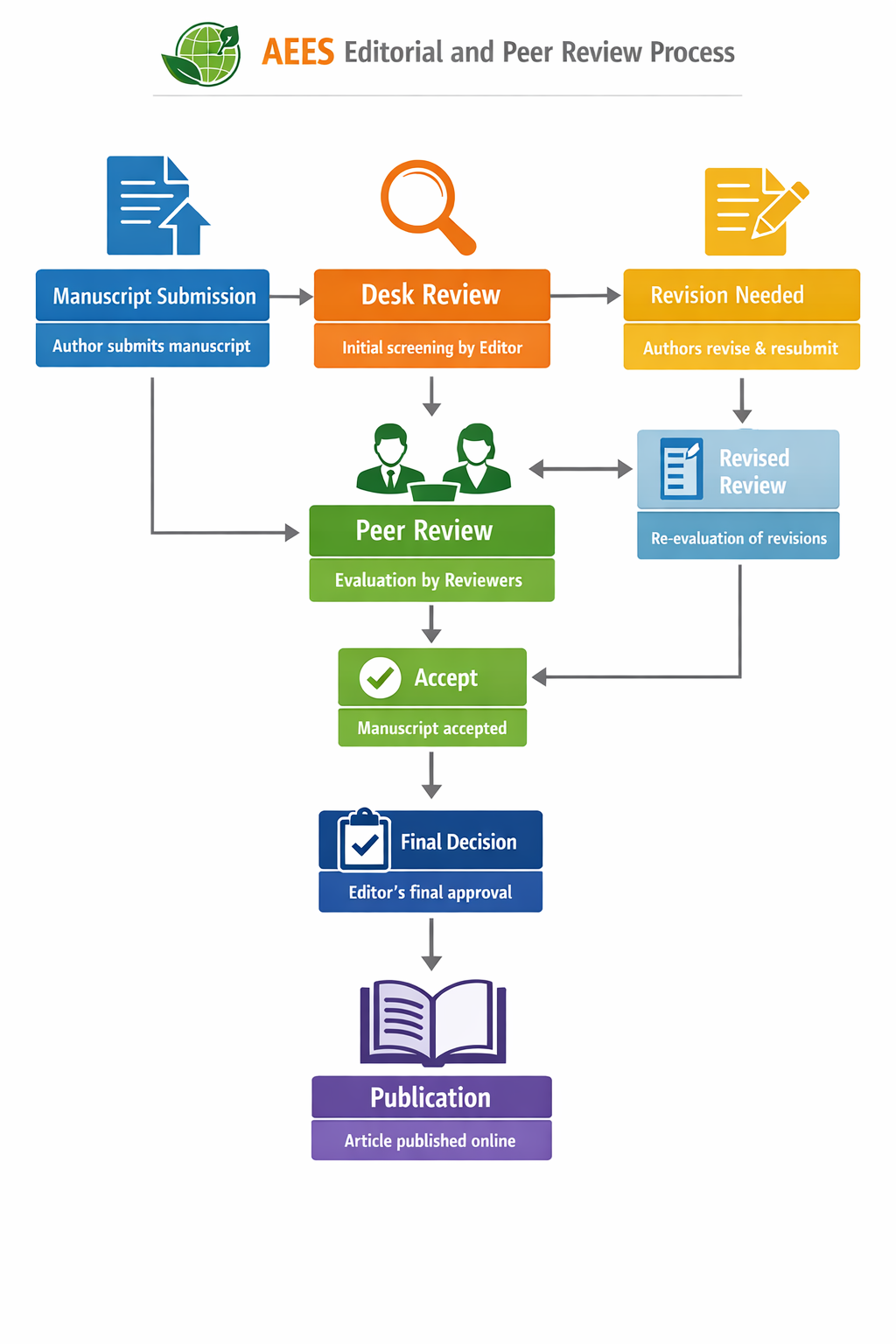
Peer Review Process Flow
Upon submission, manuscripts undergo an initial editorial check to ensure alignment with the journal’s scope, adherence to formatting standards, and minimal reporting requirements. Eligible manuscripts are then assigned to expert reviewers based on their subject matter expertise and independence. At least two independent reports are required for decision-making, with additional methodological or statistical review as necessary. All communications, assignments, versions, and decision rationales are recorded in OJS to maintain a complete audit trail.
Reviewer Selection and Verification
Reviewers are selected based on their expertise in the manuscript’s methods and domain, rather than solely on keyword matches. Potential conflicts of interest are assessed, including prior collaborations and professional relationships. Reviewer identities are verified through institutional email, ORCID records, or editor knowledge, and the use of fake or proxy reviewers is strictly prohibited.
Blinding and Confidentiality
Submitted manuscripts are anonymized prior to review, and authors must prepare blinded versions according to journal guidelines. Reviewers must not attempt to identify authors and must inform the editor if identities are inadvertently revealed. Manuscript content, including data and images, must not be shared, stored externally, or used for personal gain. Local copies should be deleted immediately after the review process concludes.
Conflicts of Interest for Reviewers and Editors
All reviewers and editors must disclose any financial or non-financial interests that may compromise their objectivity. Assignments are declined if a material conflict exists. Editors do not handle submissions in which they have a personal, collaborative, or competitive conflict, ensuring impartial editorial decisions.
Use of AI and External Tools
Reviewers and editors are prohibited from uploading any manuscript content including text, data, images, or code to third-party AI systems. If translation or accessibility tools are required, only local, non-transmitting solutions may be used, with strict confidentiality maintained. Author use of AI tools must be disclosed as per the journal’s AI policy.
Reviewer Conduct and Quality
Reviewer reports must be constructive, courteous, and focused on scientific content, including methodology, data interpretation, and overall clarity. Coercive citation requests, irrelevant critique, or requests for data/code for personal research are strictly forbidden. Any data access requirements must be routed through the editor.
Co-Reviewing and Mentorship
Invited reviewers may involve a trainee or junior co-reviewer only with prior editor approval. The co-reviewer’s identity must be recorded in OJS, and the invited reviewer remains fully accountable for the content and confidentiality of the report.
Timelines and Revision Cycles
Standard review deadlines are communicated in reviewer invitations. Reviewers unable to meet deadlines must decline promptly. Editors limit the number of revision cycles to ensure efficiency, requesting additional rounds only when substantial new evidence or significant methodological changes are presented.
Integrity Checks During Review
Editors may request raw data, original images, or approvals to clarify concerns raised by reviewers. Any signals of potential misconduct are escalated according to the journal’s research ethics procedures. Reviewers must report concerns only to editors and must not contact authors directly.
Editorial Decision and Communication
Editors synthesize reviewer input and their own assessments to produce a clear decision letter for authors. In cases of conflicting reviews, editors may assign an additional adjudicative review or targeted evaluation of the disputed aspects. Decision letters clearly outline required actions, prioritized by importance.
Sanctions and Reviewer Removal
Violations of confidentiality, reviewer identity fraud, coercive citation, undisclosed conflicts of interest, or misuse of manuscript content may lead to immediate removal from the reviewer pool. Institutions or funders may be notified, if necessary, in addition to other corrective actions as guided by COPE and journal policies.
Publication Charge Policy
The Journal of Animal Ecology and Environmental Sustainability (AEES) is committed to open access publishing and does not impose any article processing charges. There are no fees for manuscript submission, no charges for rejected articles, and no additional costs based on article length, figures, or supplementary data. All types of content, including manuscripts, editorials, teaching modules, corrections, addendums, retractions, comments, and more, are published free of charge. If APC is introduced in future, authors will be notified
Publishing Policy
The Journal of Animal Ecology and Environmental Sustainability (AEES) upholds the highest standards of ethical publishing and takes any issues related to copyright infringement, plagiarism, or other ethical violations very seriously. The rights of authors are safeguarded while investigating any claims of misconduct. If an article is found to contain plagiarized content, use third-party copyrighted material without proper permission or acknowledgment, or if authorship is disputed, the journal reserves the right to take corrective action. These actions may include, but are not limited to, publishing an erratum or corrigendum, retracting the article, reporting the issue to relevant authorities, or pursuing legal action.
Authors are required to disclose any potential conflicts of interest and ensure that proper attribution, acknowledgment, and permission are obtained for any previously published work.
Publication Malpractice Statement
The Journal of Animal Ecology and Environmental Sustainability (AEES) follows the ethical publication guidelines established by the Committee on Publication Ethics (COPE) and adheres to the standards outlined by the Higher Education Commission (HEC). All authors, reviewers, and editors are expected to comply with the publication ethics set forth by the International Committee of Medical Journal Editors (ICMJE).
Accessibility Policy and Open Access Statement
We are committed to enhancing the accessibility of our published content to ensure maximum readability without interruption. All articles are processed through the Open Journal System (OJS), which automatically generates HTML files and converts documents into compatible formats for easy online access.
Open Access Statement
This is an open-access journal, meaning that all content is freely available to users without any charges. Users can read, download, copy, distribute, print, search, or link to the full texts of the articles for any lawful purpose, without needing to obtain permission from the publisher or authors. All articles are available online immediately after publication. Non-commercial and commercial use and distribution are permitted, as long as the author and journal are properly credited.
Authorship Policy
Authorship Credit
Authorship credit is only given to those who have made a substantial contribution to the development of the article. The corresponding author is responsible for ensuring that all co-authors are credited appropriately and that they have approved the final version of the manuscript for publication. Individuals who contributed to the study but did not qualify for authorship should be acknowledged in the "Acknowledgments" section.
Changes in Authorship
Once an article is accepted for publication, changes in authorship, such as additions, deletions, or rearrangements, are not permitted unless approved by the journal’s editor. Requests for such changes must include (a) the reason for the change and (b) written confirmation from all authors agreeing to the changes. Any requests made after acceptance may delay the manuscript's publication and may not be entertained if the article has already been published online.
Order of Authors
The order of authors should be mutually agreed upon before submitting the manuscript. Disagreements regarding author order should be resolved prior to submission.
Affiliation Policy
Authors must list accurate and current institutional affiliations. Changes are allowed before publication; after publication, affiliations remain unchanged. Authors with multiple affiliations should indicate the order of primary, secondary, or tertiary institutions, limited to ten. Independent researchers must explicitly state their status.
Guest Authorship
Guest authorship, where individuals are listed as authors without making significant contributions, is strictly prohibited. AEES does not allow guest authors on articles.
Anonymous Authorship
Authorship must be transparent and publicly accountable. Pseudonyms or anonymous authorship are not allowed, except in rare cases where authors can demonstrate credible reasons, such as threats to personal safety or loss of employment. In such cases, an editor may consider publishing anonymously.
Acknowledgment
In the acknowledgments section, authors should mention individuals whose contributions did not warrant authorship but who played a significant role in the research.
Contributors
AEES does not permit "ghost" or "guest" authorship. Only individuals who have made substantial scientific contributions to the manuscript should be listed as authors. This includes researchers, students, and lab technicians who have contributed meaningfully.
Duplicate Submission
Manuscripts that have been previously published or are under consideration elsewhere will be considered as duplicate submissions. If authors use previously published work (including work under review), they must properly cite the previous publication and clarify how the new manuscript offers novel contributions.
Citation Manipulation
Manuscripts found to engage in citation manipulation—where citations are used to artificially inflate the citation count for a particular author or journal—will be rejected. AEES maintains strict policies against this practice.
Accessibility, Inclusivity, and Awareness
AEES is committed to producing content that is inclusive, accessible, and ethical. Authors are encouraged to provide clear graphics, alt-text, and proper labeling. The journal regularly conducts workshops and training programs to raise awareness about research integrity, ethical publishing, and inclusivity.
Corrections and Retraction Policy
Authors who identify errors in their published articles should contact the journal's editorial office, providing a detailed description of the required correction. Both corrigenda (corrections of author’s errors) and errata (corrections of publisher’s errors) will be published at no charge to the authors. Corrections that impact the interpretation or conclusions of a published article will be reviewed by the editorial team.
An article may be retracted if its integrity is significantly compromised due to errors in the study’s conduct, analysis, or reporting, or if there has been a violation of publication or research ethics. If an article is retracted, the original publication will be marked as retracted, but the PDF version will remain accessible to readers, with the retraction statement linked to the original article. Retraction statements will typically include a note of agreement or disagreement from the authors.
In exceptional cases, the editorial office may remove an article from the journal’s online platforms. Such actions may occur when:
§ The content is defamatory, infringes on intellectual property or privacy rights, or is otherwise unlawful.
§ A court or government order mandates the removal of the content.
§ The content poses an immediate and serious risk to health.
The removal may be temporary or permanent. Bibliographic metadata, such as the title and authors, will be retained with a statement explaining the reason for the removal.
Metadata, and Discoverability
Authors are encouraged to provide ORCID IDs to ensure accurate attribution. The journal ensures that article metadata, including authorship, funding, abstracts, and references, is deposited with Crossref and other indexing services to maximize discoverability.
Digital Archiving Policy
The Journal of Animal Ecology and Environmental Sustainability (AEES) is committed to ensuring that all published materials are securely stored on digital archives, making articles accessible to readers even if the publication is discontinued or lost. To ensure long-term accessibility, all articles are deposited into trusted preservation services and archives.
AEES articles are digitally archived through the PKP PN Preservation Networks (LOCKSS), (CLOCKSS)and the Internet Archive regularly. The journal ensures that its metadata is compatible with major repository services, allowing their digital crawlers to collect and preserve the content. Additionally, AEES assigns Digital Object Identifiers (DOIs) to all issues and articles to provide permanent, accessible links to the content. The journal’s management system also self-archives data on UMT servers regularly to ensure continued access.
Confidentiality Policy
The editorial team and publication staff at AEES are committed to maintaining the confidentiality of all submitted manuscripts. Information about the submitted articles is shared only with those involved in the review and publication process in accordance with the journal’s policies. To support a transparent double-blind peer-review process, the journal operates through an automated management system that ensures confidentiality.
Editors are encouraged to include confidentiality notices in all correspondence, including reviewer forms, to remind authors, editors, and reviewers of the need to maintain confidentiality.
Conflict of Interest Policy
AEES requires authors, reviewers, and editors to disclose any potential conflicts of interest that could affect their judgment regarding the publication of an article. According to the Committee on Publication Ethics (COPE) guidelines, conflicts of interest may arise when authors, reviewers, or editors have personal, professional, or financial interests that could influence their decisions. Such conflicts can mislead readers or compromise the integrity of the publication.
AEES asks authors to disclose any relationships, affiliations, or financial interests that could be seen as a conflict. These may include, but are not limited to, the following:
§ Fees received for consulting or research funding.
§ Employment by a company with a direct interest in the article.
§ Ownership of stocks or shares in a company that could be affected by the publication.
§ Funds received for attending related conferences or symposia.
Authors should declare any competing interests that might affect the research. However, financial arrangements are not required to be disclosed unless relevant to the conflict. Manuscripts will be evaluated fairly, regardless of whether conflicts of interest are declared.
Conflict of Interest
In cases where a conflict of interest arises or is identified, the editors may request additional information from the author, including but not limited to the following:
§ Disclosure of any financial support or sponsorship received for the research or manuscript submission.
§ Disclosure of any commercial or financial relationships that may represent a conflict of interest in relation to the submitted contribution. Authors should include such disclosures in a covering letter with the submission, and the editor will assess whether such information should be published alongside the article.
§ If there is an agreement with a research sponsor that restricts the publication of both positive and negative results or requires prior approval before publishing, this must be disclosed.
§ Confirmation that the authors have reviewed the manuscript submission guidelines and adhered to any requirements regarding conflict-of-interest declarations, including signing the Copyright and Author Consent Form upon submission.
Editor Obligations Regarding Conflict of Interest
Editors and guest editors are bound by the same conflict of interest obligations as authors. If you are submitting or publishing an article in a journal that requires the declaration of conflicts of interest, please include this declaration at the end of the manuscript, following the acknowledgements and before the funding acknowledgements, notes, and references, under the heading "Declaration of Conflicting Interests." If no conflict exists, please state: "The Author(s) declare(s) that there is no conflict of interest."
Please note that a Conflict-of-Interest Statement will not appear in journals that do not require such a declaration. Where a declaration is required, it must be specific and include any financial relationships that all authors have with sponsoring organizations, as well as any for-profit products discussed or implied in the manuscript.
Privacy Policy
The Journal of Animal Ecology and Environmental Sustainability (AEES) respects the privacy of authors and users, ensuring that personal information is protected in accordance with the Intellectual Property and Copyrights Ordinance 1962. This privacy policy applies to all personal information provided through the journal's website, excluding publicly available information and data provided to the staff of UMT journals. AEES is committed to upholding research ethics, including confidentiality, consent, transparency, and integrity in all interactions.
We collect personal information to facilitate communication, gather feedback, and keep users informed about the journal's latest news and events. This may include details such as name, email address, academic qualifications, professional affiliations, address, contact number, and other voluntarily provided information through forms on the website. Users are not required to provide personal information to browse, view, or download articles from the website.
While users may choose not to share personal information, certain services, such as manuscript submissions, require specific details, including the author’s name. The journal will not share personal information with third parties, and personal data will be retained only for as long as necessary to fulfill its purpose or until a user requests removal.
If a user wishes to have their personal information removed, they may contact the journal via the "Contact Us" page. The journal may not collect sensitive data such as gender, zip code, date of birth, financial information, or other personal details unless required for specific services. We use collected information to improve the quality of services and ensure our users are up-to-date with the journal’s activities.
By using the website, users agree to the terms of this privacy policy. AEES reserves the right to modify the privacy policy as needed, and users are encouraged to review it regularly for updates. If you do not agree with any of the terms, you should exit the website immediately.
Anti-plagiarism and Anti-predatory Procedures
The Journal of Animal Ecology and Environmental Sustainability (AEES) maintains a strict editorial policy against plagiarism and unethical publishing practices. We welcome original contributions that are not under consideration elsewhere. Authors must ensure that the content submitted is based on their own research and expressed in their own words. Plagiarism is considered unethical and unacceptable. As part of our Copyright Policy, we provide guidelines on what constitutes acceptable practices to help authors avoid plagiarism. These guidelines are designed to protect the integrity of authors' work and to maintain the quality of the journal. The peer review process adheres to the standards set by the Higher Education Commission (HEC) and ensures quality control.
Types of Plagiarism to Avoid:
§ Verbatim Copying: Copying more than 10-15% (or a significant passage) of another person’s work without appropriate citation, references, or quotation marks.
§ Improper Paraphrasing: Paraphrasing without proper attribution, particularly when more than one sentence or paragraph has been altered without credit. Significant improper paraphrasing (over 10%) is treated as seriously as verbatim copying.
§ Reusing Parts of a Work without Attribution: Reusing elements such as figures, tables, or paragraphs from another’s work without proper citation, quotation marks, or permission from the copyright holder.
§ Self-plagiarism: Authors must confirm that their submitted work has not been previously published elsewhere. If parts of the work have been published, these must be properly cited, and the manuscript must explain how the new work differs or builds upon the previous research. Verbatim copying or improper paraphrasing of the author’s own work is not acceptable, and research should only be reused to support new conclusions.
We recommend authors cite any previous presentations, such as conference papers or workshop presentations that contributed to the final work. This will help maintain a complete record of all communications related to the research.
Republication of Original Work:
Only original and innovative research will be considered for publication, with a few exceptions such as conference papers or archival papers published in special issues at the discretion of the editor. Proper attribution and permission from the relevant copyright holder must be obtained for any previously published work. The author must also include a statement about the republishing in compliance with ethical standards at the end of the manuscript.
Attribution:
References must be formatted according to the AMA Manual of Style. Authors should ensure that references are complete, accurate, and consistent, including full author names, initials, and full journal titles.
Handling Allegations of Plagiarism:
AEES takes allegations of plagiarism very seriously and upholds academic integrity by protecting authors’ rights. We have established procedures to address allegations of plagiarism. Editors thoroughly investigate each case and seek clarification from all relevant parties. If a third party brings an allegation to the journal, we will first seek a response from the authors or copyright holders before deciding on any actions. Our approach will remain objective and unbiased.
The journal uses tools such as Turnitin to assist in identifying potential plagiarism. We will not discuss individual cases with third parties and reserve the right not to proceed with a case if the complainant acts inappropriately or provides false information.
Prior Publication:
A manuscript or significant part of it that has been previously published is generally not acceptable for publication in the journal. However, conference abstracts and posters may be considered, provided that the author informs the editor and acknowledges the original publication source. Articles presented at conferences but not published by the conference organizers may also be considered, provided the author retains the rights to the work and confirms that the version submitted to AEES differs from the version presented at the conference. Authors must disclose any prior publications and ensure appropriate attribution in the manuscript.
Informed Consent Policy:
Authors are responsible for ensuring that all research involving human subjects complies with data protection and confidentiality standards. Authors must adhere to the specific policies of biobanks, biorepositories, or any other data provider to ensure ethical standards are met.
§ For research involving human participants, authors must obtain and document freely-given informed consent to participate in the study. If the study involves children under 16, consent must be obtained from a parent or legal guardian. This consent statement must be included in the manuscript.
§ For studies involving vulnerable populations where there may be potential for coercion or lack of fully informed consent, extra care will be taken, and the manuscript may be reviewed by the Advisory/Editorial Board for additional ethical oversight.
§ Authors must also obtain consent from individuals to publish their data prior to submitting the manuscript. This is particularly important for case studies.
§ The manuscript should include a structured declaration, which must cover funding, conflicts of interest, ethical approval, consent, data and/or code availability, and authors’ contributions. This declaration should appear before the References section.
Advertisement Policy:
The Journal of Animal Ecology and Environmental Sustainability (AEES) does not accept or publish any advertisements in the journal.
Open Access, Copyright, and Licensing Policy
All articles published in Animal Ecology and Environmental Sustainability (AEES) follow a Gold Open Access model. By default, publications are licensed under Creative Commons Attribution 4.0 International (CC BY 4.0). Any journal-specific exceptions (e.g., CC BY-NC or CC BY-ND) are only applied when required by funders or societies, and these exceptions will be explicitly listed in the Journal-Specific Appendix.
Copyright Ownership
Authors retain copyright of their work. Authors grant Animal Ecology and Environmental Sustainability (AEES) a non-exclusive, irrevocable, worldwide license to publish, distribute, preserve, translate, and index the Version of Record (VoR) under the selected CC license. Authors may reuse their article in any context or format, provided proper attribution to the VoR is maintained, in accordance with the CC license.
Rights Granted by the License (CC BY 4.0)
Under CC BY 4.0, anyone can share (copy and redistribute) and adapt (remix, transform, build upon) the work, including for commercial purposes, provided that they:
o Give appropriate credit to the authors;
o Provide a link to the license;
o Indicate if changes were made;
o Do not suggest endorsement by the authors or journal.
Other CC variants, if approved for specific articles, carry narrower reuse permissions and must be followed exactly.
License Display and Metadata
The chosen CC license is clearly displayed on the article webpage, the PDF front page, and embedded in the metadata. License information is deposited with Crossref, enabling text- and data-mining (TDM) systems to recognize reuse rights automatically.
Third-Party Materials
Authors must ensure that any third-party content (figures, tables, images, questionnaires, proprietary scales, maps, artwork) is either:
o Created by the authors themselves;
o Licensed in a manner compatible with the article’s CC license; or
o Used with written permission from the rights holder.
All third-party materials not covered by the article’s license must include a credit line specifying the rights holder, license or permission, and any restrictions. Materials without proper permissions must be replaced or removed before publication.
Manuscript Versions and Sharing
Preprints: Allowed per journal preprint policy.
Author Accepted Manuscripts (AAM): Can be posted to personal, institutional, or public repositories immediately upon acceptance. AAMs must be labeled as such, with a link to the VoR DOI once available.
Version of Record (VoR): May be shared and reused under the selected CC license. Citation and DOI linking to the VoR are mandatory.
Text and Data Mining (TDM)
TDM is permitted under the article’s CC license without additional approval. Users should respect technical safeguards such as rate limits to maintain platform stability.
Author Warranties
By submitting, authors confirm that:
o The work is original, lawful, and does not violate copyright or other rights;
o Permissions for third-party materials are obtained and correctly credited;
o The manuscript is free from defamatory or unlawful content;
o Required approvals and consents (ethical, institutional) are in place;
o Any AI-assisted content is disclosed and does not breach third-party licenses.
Trademarks, Logos, and Endorsements
CC licenses do not grant rights to use others’ trademarks or logos.
Reuse must not imply endorsement by the authors or the journal. Product and trade names are for identification only.
Commercial and Author Reuse
Commercial reuse (including translations, compilations, and educational platforms) is allowed under CC BY 4.0 with proper attribution.
Authors may reuse their content in books, lectures, theses, or derivative works, provided the VoR is cited and third-party credit lines are respected.
Takedown Requests and Disputes
Concerns regarding rights or privacy should be reported to contact@aeesjournal.com. The journal will evaluate requests promptly and may issue corrections, metadata updates, or exceptional removal with a tombstone record. Communications regarding disputes are logged in the journal system.
Recommended Attribution
© Author(s) [Year]. This is an open-access article distributed under the terms of the Creative Commons Attribution 4.0 International (CC BY 4.0). To view a copy of this license, visit CC BY 4.0. Cite as: [full citation with DOI].”
Policy Updates
Any updates to licensing practices will be published on the journal website.
Articles published before changes remain under the license specified in the VoR at the time of publication.
Summary of the License Agreement:
Under the Creative Commons Attribution 4.0 International (CC BY 4.0) license, authors retain copyright while granting the journal the right of first publication. The work is licensed under CC BY 4.0, which allows others to:
o Share the material in any medium or format, including redistribution.
o Adapt the material by transforming, remixing, and building upon it for any purpose, including commercial uses. Under the following conditions:
o Attribution: Proper credit must be given to the original authors, a link to the licensing body should be included, and any changes made must be clearly specified. This should not imply that the licensor endorses the user or their use.
o No additional restrictions: Authors should not use legal or technological measures that restrict others from using the material in accordance with the terms of the license.
AI Policy:
The use of artificial intelligence (AI) tools, such as ChatGPT or other Large Language Models (LLMs), in research publications is becoming increasingly common. The Committee on Publication Ethics (COPE), alongside organizations such as WAME and the JAMA Network, has issued guidelines regarding the role of AI in authorship:
1. AI tools cannot be listed as authors: AI tools cannot meet the criteria for authorship, as they cannot take responsibility for the submitted work.
2. Transparency in AI use: Authors who use AI tools in writing, producing images, graphical elements, or collecting and analyzing data must clearly disclose how the AI tool was used and specify which tool was employed in the Materials and Methods (or similar) section of the paper.
3. Author responsibility: Authors retain full responsibility for all aspects of the manuscript, including content produced by AI tools, and are liable for any breaches of publication ethics.
This policy document has been adopted from COPE. For more information, please refer to COPE's full guidelines.